
Playbook content
Intro
“I’m a consumer researcher living in the age of AI. What do I need to know? I heard it is jeopardizing some industries and skills. Do I need to be concerned? How deep do I need to explore? Should I embrace or be against it? In what way do I need to learn to use it?”
These were the questions that brought us, researchers, together, and what made the Ctrl+Shift! initiatives exist in the first place.
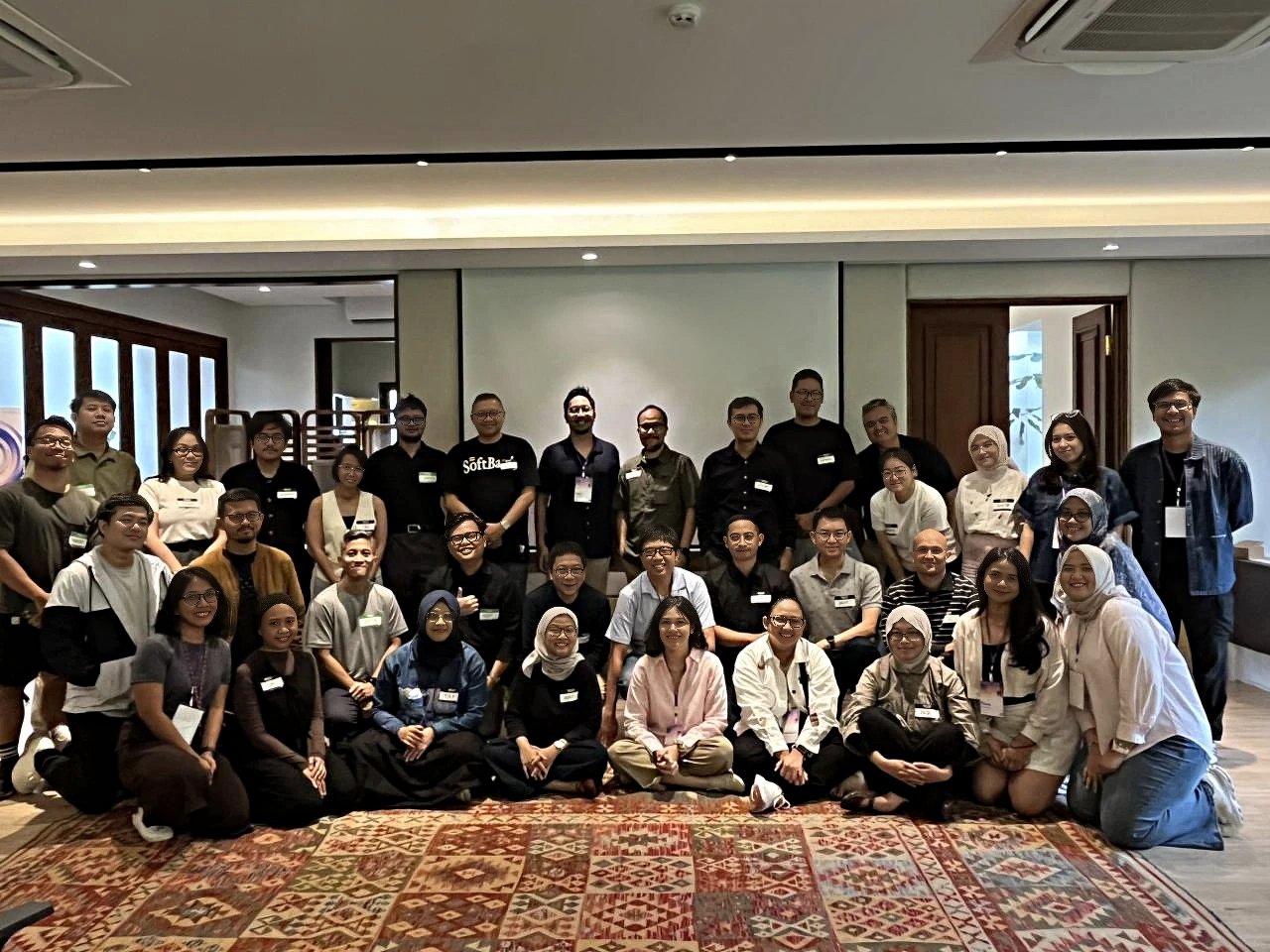
There were, so far, 2 offline events where researchers and users of research (product, design, business) gathered to discuss the matter. The first one was attended by 100+ enthusiasts; while the workshop on the 2nd event was capped at 30 participants.
The discussions involved a wide range of attendees from across Indonesia, various research experience levels including industry leaders and across industry. Hence the changing of research and AI-related experiences were rich to contribute to the thinking of how we, as researchers, would be best to approach the new technology.
This playbook is documenting the discussions that came out of it that we can refer to from time to time.
A note on what you won’t find here.
You won’t find specific tool recommendations or prompting templates in this playbook. That’s deliberate.
Special gratitude for:
Volunteers
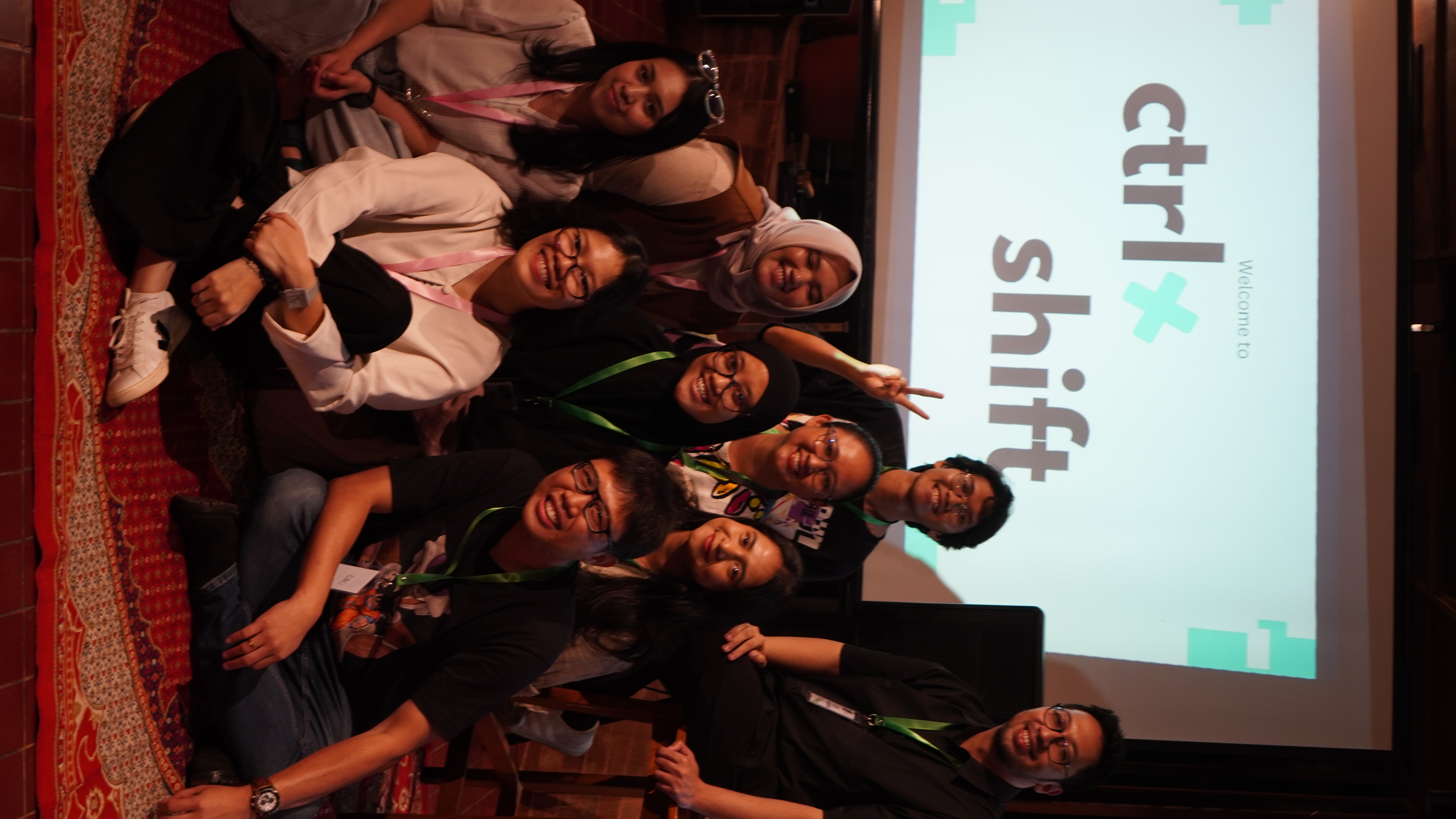
Puspa Citra Anjani (Citra), Dea Chandra Marella, Fisca Gupita, Stephanie Pradnyaparamita, Tiffany Dewi Setyaningrum, Anggun Rachmawati, Musyafa (Wafa) Syahbid, Irvan Hidayat, Andika Eka Buana, Arie Aulia Nugraha
Initial Ideators
Adri Reksodipoetro, Indriansyah Febrialdy, Annisa Nur, Ditto Priyawardhana, Amanda Melissa, Agustinus Andreas Teguh Kusuma (Teguh)
30+ Workshop Participants
Adinda Angelica, Adisti Latief, Aditya Wicaksono, Adri reksodipoetro, Adwitya Nugrahawati, Albert Christian, Amanda Melissa, Annisa Jumaniar, Arie Aulia Nugraha, Dea Safirahilda, Ditto Priyawardhana, Fajar Lubis, Haris Fajar Rahmanto, Hidayatullah Cahyatama, Indriansyah Febrialdy, Iwan Murty, James Dewanto, Nanda Bagus Prakosa, Nizar Maulana Azhari, Novrizal Kamal, Raditya Bayu Pramono, Raihan Abimanyu, Ramda Yanurzha, Sarah Shafira Novianti, Tika Widyaningtyas, Ukasyah Q.A.P., Varyan Aryo, Wanda Azizah Yasin
Playbook Content Editor
Adri Reksodipoetro
Playbook Designer
Arie Aulia Nugraha
As AI is evolving in its nature, this playbook too is aiming to be updated following the flow of the fast moving AI.
Tools change. Models change. The way we communicate with AI today may look very different six months from now. What we’ve tried to capture here are the principles and judgment calls that should hold up regardless of which tool you’re using. For the faster-moving, more technical stuff, we’ll share those separately in places/avenues that are easier to keep updated.
This playbook is meant to be the slower layer. The part that doesn’t go stale.
July, 2026
Rajiv Ibrahim, Danisya Kartohadiprodjo, Christian Hermawan.
Section 1: General Principle of AI in Research
The shift is real. The pressure is rising.
This space is still ours to shape. Step in before the lines are drawn without us.
Move forward with intent and deep understanding.
AI must be thoughtfully intertwined with the research process,
not just layered on top of it.
Generative AI’s emergence is fundamentally altering life, notably impacting corporate researchers. Consequently, the potential disruptions driven by AI necessitate careful consideration.
In the research domain, AI is a distinct tool compared to previous technologies. It presents an opportunity to revolutionize research practices, making them both faster and more cost-effective. This is definitely an exciting prospect for both researchers and stakeholders.
Before we talk about how to use AI, it’s worth being clear about what we’re working with.
Principle 1
1. AI has knowledge about humans, but only the tip of the iceberg.

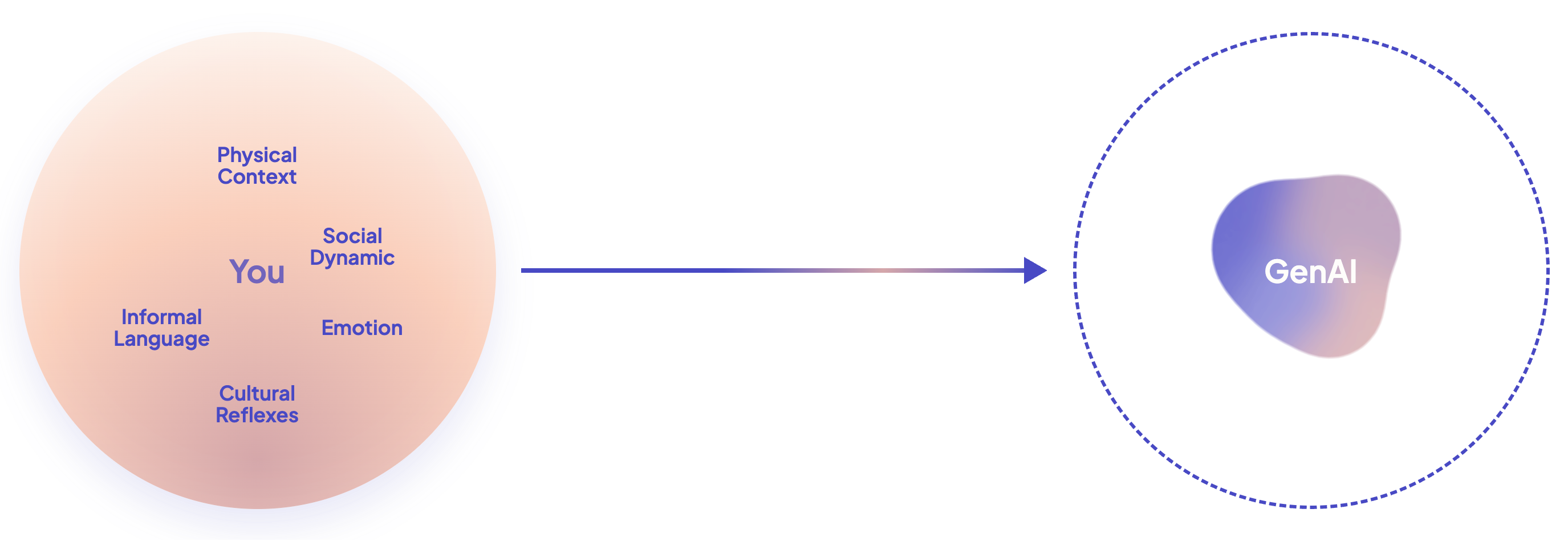
Generative AI is trained on vast amounts of information that humans have written on the internet about ourselves. Meanwhile most things we do, think and feel are hard to explain in words or are simply reflexes in response to our (social, physical, cultural) context which GenAI cannot “see”.
Two things are useful to understand humans:
- Linguistic nuances e.g. slang, which AI gets to some extent but indeed may miss.
- Context, non-verbal, intent, emotion, which AI cannot possibly know
Both of these things are especially important in high context cultures like Indonesia.
Worse, when it hits a gap in its training data, it tends to fabricate rather than admit the gap. So even when AI sounds informed, it isn’t necessarily reliable.
Principle 2
2. AI sounds confident even when it’s wrong.

The bigger danger isn’t the gap itself. It’s how AI presents the gap. Outputs come back fluent, polished, and persuasive, whether they’re accurate or completely fabricated.
The risk is a degradation of research quality hidden under elegant language, that leads to poor business decisions based on it. Over time, that erodes trust in the research itself. Verification has to become a habit, not a final-step audit.
Principle 3
3. AI has a heavily Western-biased worldview.

As of 2024, only around 1% of AI models were trained using Indonesian language source. But the broader pattern matters more than the number: AI is heavily weighted toward English-language data and Western cultural reference points.
Put simply, when we ask GenAI to analyse Indonesian people, we are using western perspectives and mental models to make sense of what Indonesians are thinking and doing.
Three Principles That Answer Them
These risks are real. But they’re not reasons to step away from AI. They’re reasons to step in with the right posture.
| Challenge | Principle | |
|---|---|---|
| 1. | AI can understand humans, but only the tip of the iceberg | Supplement your data analysis with everything GenAI cannot see (look beyond text and words: physical context, emotion, social politeness, cultural nuances, etc). Use your human intelligence and human senses to complete its understanding. |
| 2. | AI sounds confident even when it’s wrong | Always start with your own thesis and perspective. Let AI critique, build on and structure your thinking, rather than initiate it. If you rely on its answers, verify through sources outside of GenAI. |
| 3. | AI has a Western-biased worldview | Prioritise your own local cultural interpretation, it’s much more valuable than you think. Don’t delegate human and cultural understanding to GenAI alone. |
In two sentences: Gen AI has a narrow text-based Western-biased knowledge base. So we need to supplement it with a real-world culturally-attuned perspective.
Key words
GenAI: Text Based, Western Biased vs. You: Context-Aware, Culturally Attuned
Section 2: The Practice
The first part gives us principles. This section turns them into practice. Every researcher reading this section is carrying the same question: when do I let AI help, and when shouldn’t I?
This section answers that, phase by phase, across the research lifecycle. Not as rigid rules, but as a way of thinking that holds up when the tools change next quarter, and the quarter after that.
The section uses three concepts, each doing one job:
- The Quadrant tells you where AI sits in any given task.
- The Spectrum tells you how to adjust the Quadrant for your specific project.
- The Loop tells you how humans and AI take turns across the work.
Quadrant + Spectrum + Loop = a working model for AI in research. The phases that follow show what this looks like in practice. The Project AI Alignment Canvas at the end of the section turns it into a stakeholder agreement.
The Quadrant
Every research activity sits between two forces:
- Task Complexity: how heavy and repetitive is the work?
- Judgment Sensitivity: how risky is it if we get this wrong?
Map these forces and four zones appear:
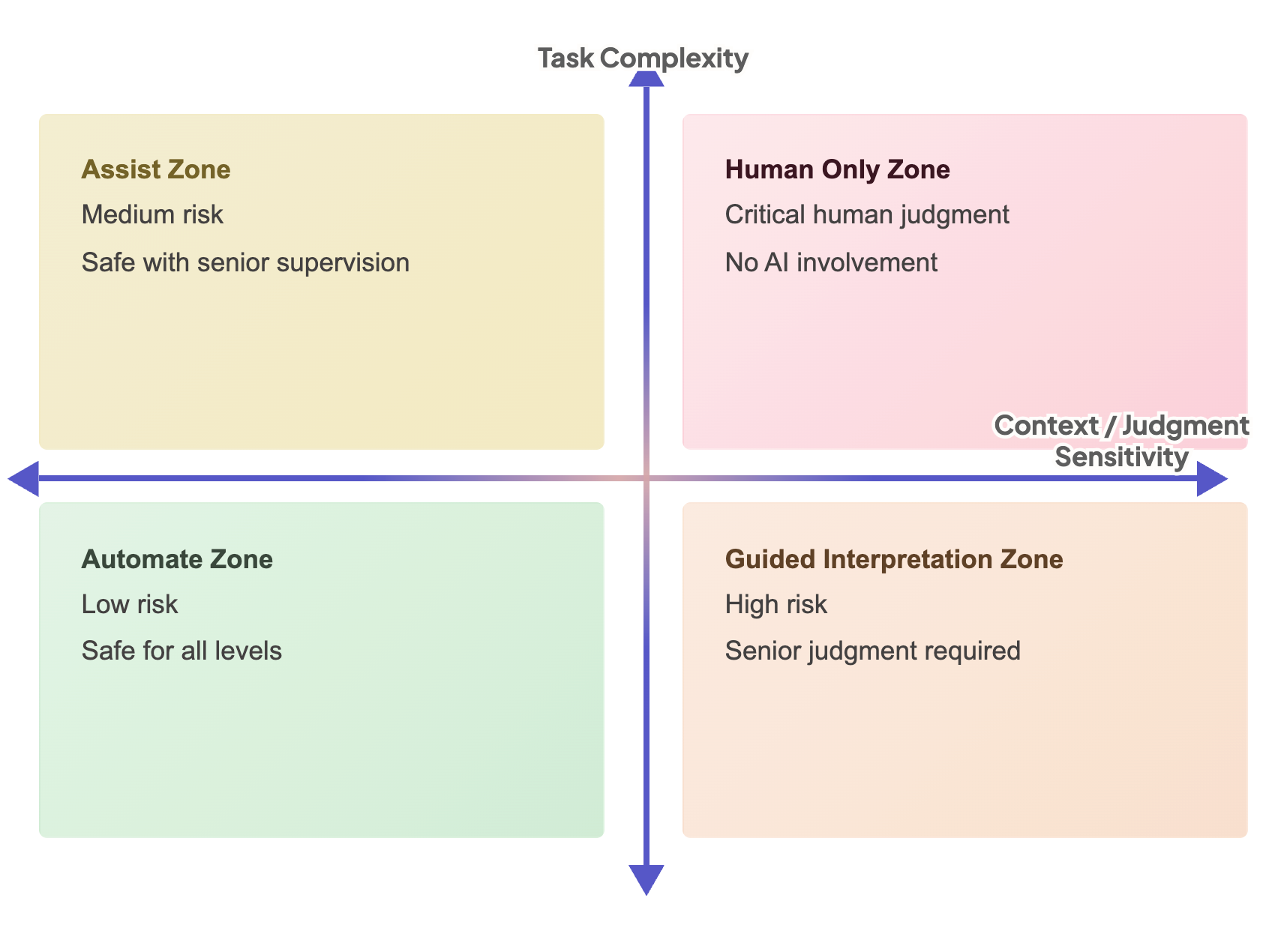
The Four Zones
- HUMAN ONLY - High judgment, real consequences. Humans lead. Always.
- GUIDED INTERPRETATION - AI explores. Humans interpret.
- AI ASSIST - AI accelerates. Humans refine.
- AI AUTOMATE - AI executes. Humans supervise.
This is not about permission. It is about responsibility.
The Quadrant gives you a default map of where AI fits across research tasks. But defaults are written for the average project, and your project isn’t average. That’s where the Spectrum comes in.
Let’s deep dive into each phase:
1-Planning Phase
Planning Phase
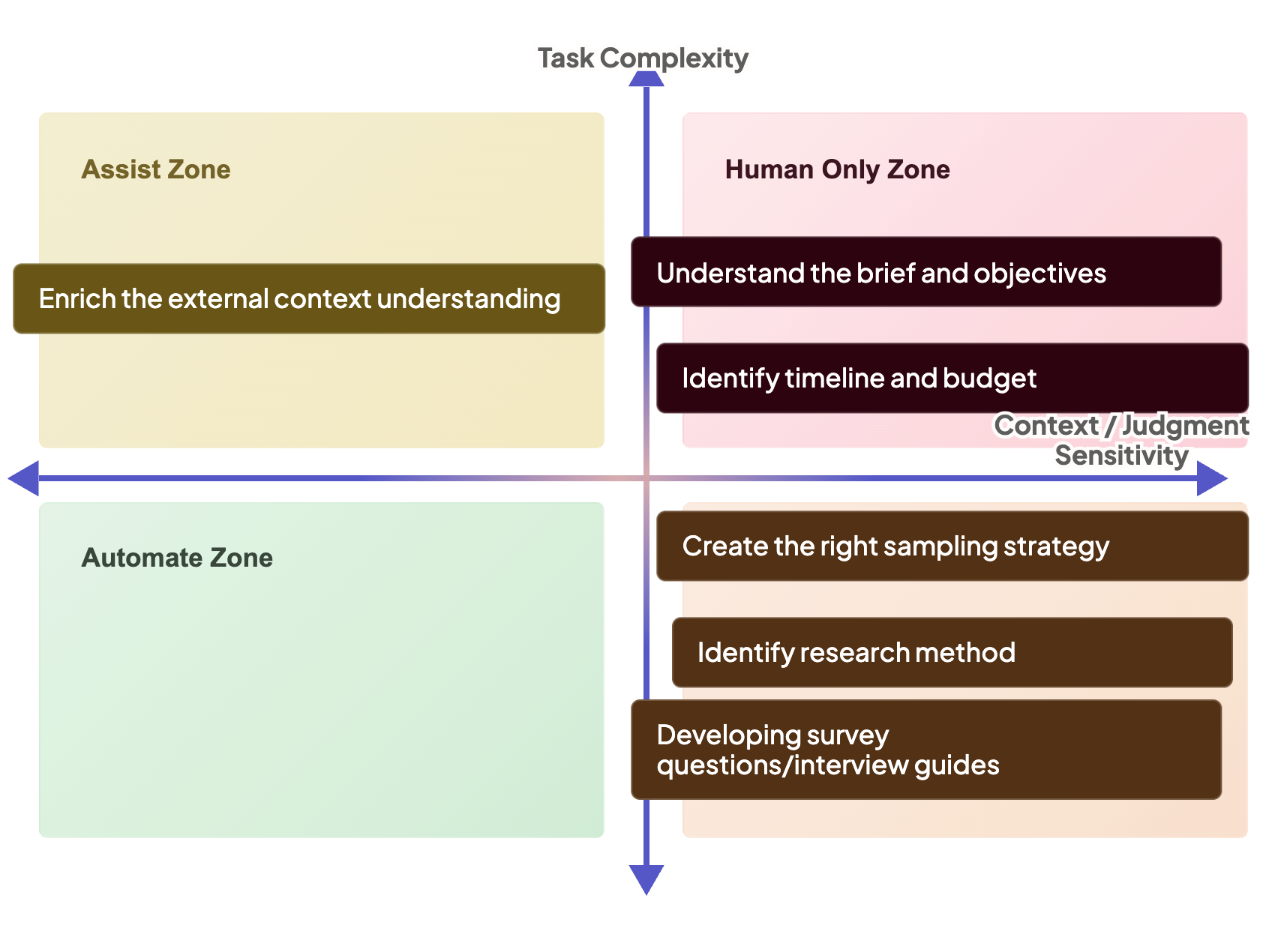
What we learn

Here the grip is at the front: nail the framing early, and AI can safely help with the rest.
The same activities, pulled into three moves:
| Step | Frame the problem | Design the study | Build the guide |
|---|---|---|---|
| Activities | Defining the problem, pinning down the objective, naming the limits: time, budget | Choosing the method, deciding who to talk to: sampling | Drafting the interview or survey guide, gathering background |
| Zone | Human only | Guided | Assist |
| Why this zone | So much of what shapes a brief is unspoken — it lives in your head and in stakeholder chats, not in a prompt. | It takes judgement to know what will actually work with real people. | Once the method is set, drafting the questions is low-risk. |
| Watch out | If AI defines the problem, it builds in its own blind spots. | AI happily ignores real limits like time and budget. | Leading questions slip in without you noticing. |
| Do this | Write the objective in your own words first. | Let AI suggest, but you make the call. | Ask AI to poke holes in your wording. |
Where AI helps most
AI is strong at structure and pressure-testing, making sure the brief hangs together, and challenging the assumptions you didn’t notice you were making.
Try
“Here's my brief and how I plan to approach it. Challenge my assumptions and point out anything that doesn't add up.”
AI is excellent at writing a research plan. It is terrible at deciding whether the research needs to happen at all.
2-Data Collection
Data Collection
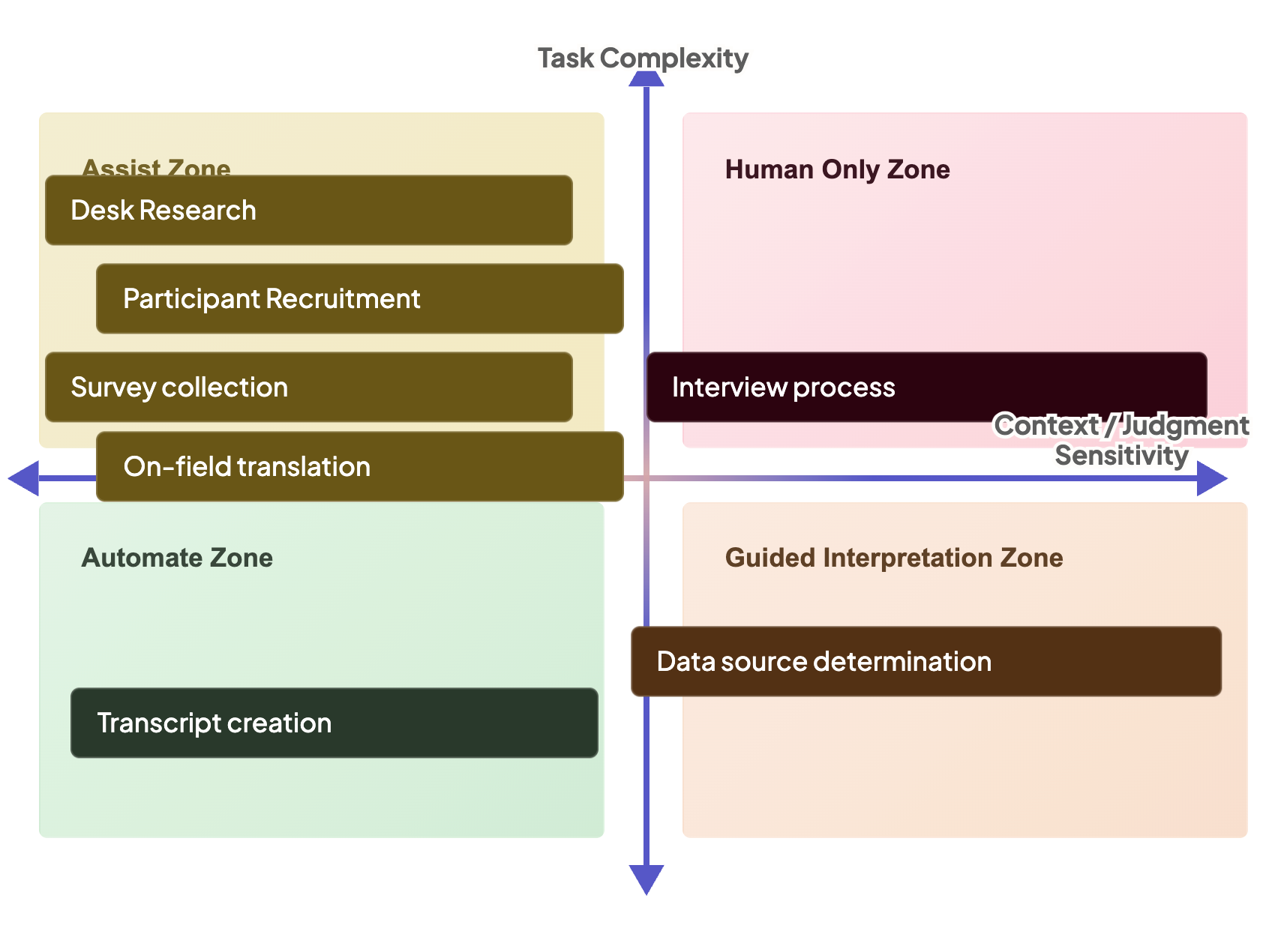
What we learn

Here the grip is in the middle: AI can handle the setup and the cleanup, but humans have to be in the room for the real conversations.
The same activities, pulled into three moves:
| Step | Recruit & set up | Interview & immerse | Transcribe & translate |
|---|---|---|---|
| Activities | Finding participants, handling survey logistics | Running interviews, spending time in people’s real settings, exploring local culture | Turning recordings into text, translating from the field |
| Zone | Assist | Human only | Automate |
| Why this zone | This is logistics, not judgement. | Real, face-to-face contact is where the meaning actually shows up. | It’s mechanical work — as long as you’ve checked the accuracy. |
| Watch out | Automated screening can let the wrong people through. | Fake or AI-run “interviews” strip out all the nuance. | Unchecked translation quietly changes what people mean. |
| Do this | Keep a human eye on who actually qualifies. | The human stays in the room. | Test the tool on a small sample before trusting it. |
Where AI helps most
AI is great at catching things while you’re still in the field, themes or contradictions popping up early, so you can dig into them in your next session.
Try
“Here are the themes from my first three interviews. What should I dig into harder next?”
If AI makes you plan fewer real conversations, something’s wrong. If it makes the conversations you do have sharper, something’s right.
A note on synthetic research
Synthetic respondents are AI-generated “people” you can interview instead of real ones. Big companies already use them, and not just to save money. They’re fast and cheap, and they let you test an idea on a thousand “people” overnight or reach a market you can’t get to yet.
Use it with care. AI gives you the answer it expects, not the surprising or specific one, and that’s often where the real insight lives. It can miss real local culture and the sensitive, human stuff. Keep it next to real research, not instead of it, with a person checking it against reality.
The tools are growing quickly, so keep an eye on them and let your confidence grow with the evidence.
3-Analysis & meaning-making
Analysis & meaning-making
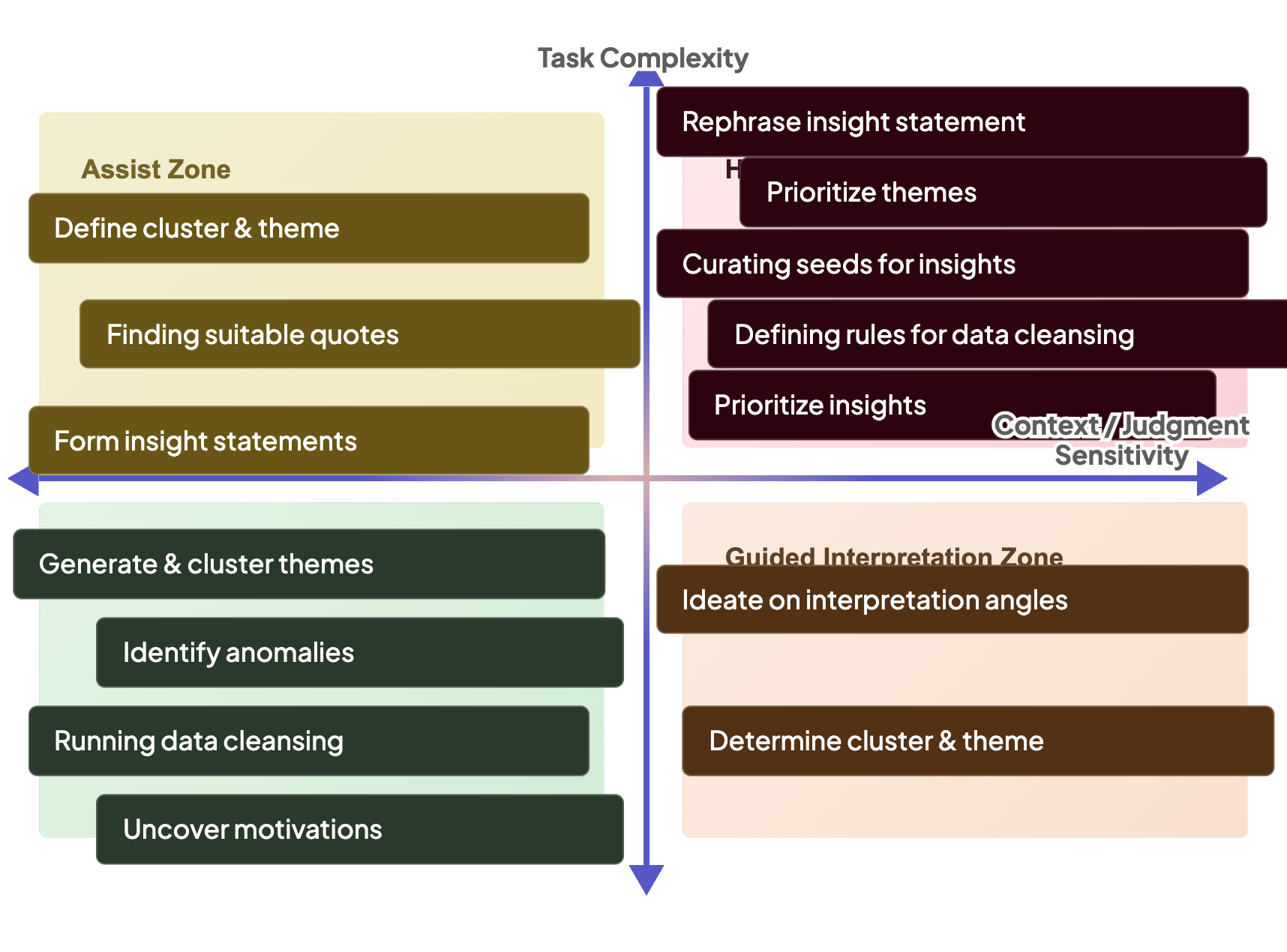
What we learn

Here the grip tightens as you go: AI can spot what’s there, but you own what it means and what to do about it.
The same activities, pulled into four moves: think of them as what’s there, why, so what, and now what.
| Step | Observations | Meaning | Implications | Actions |
|---|---|---|---|---|
| Activities | Cleaning the data, grouping and labelling themes, flagging odd cases, pulling good quotes | Exploring different readings, working out what drives people | Deciding which themes matter, choosing the seeds of an insight, ranking them, writing them up | Pressure-testing the options, deciding what to recommend |
| Zone | Automate | Guided | Human only | Human only |
| Why this zone | “What’s there.” Spotting patterns across lots of data is mechanical work. | “Why it’s there.” Meaning and insights live beyond what people say. The why needs cultural context AI doesn’t have, especially here. | “So what.” Only you know what your stakeholders actually care about. | “Now what.” The recommendation is yours to stand behind. |
| Watch out | Themes you can’t trace back to what people actually said. | AI reading local behaviour through a Western lens. | Findings that describe what happened but never explain it. | Conclusions you didn’t really form yourself feel empty to everyone else. |
| Do this | Check 10–15% of it by hand against the raw data. | You read the meaning — especially for local context. | Run the “so what” test below. | Pressure-test with AI, then you decide. |
Where AI helps most
AI can widen what you notice, e.g. the rare signals, the contradictions, and how solid a pattern really is, far beyond what one person can hold in their head.
Try
“Here are my coded themes. Show me the rare signals I might have underweighted, and any pattern that contradicts my main read.”
The “so what” test: would the business actually change if this finding vanished? Does it explain why people behave this way, or just describe what they did? Would a leader make a different decision because of it? If not, it’s a pattern, not an insight.
Transcripts and datasets tell you very little on their own. The meaning lives beyond what people literally said.
4-Reporting
Reporting
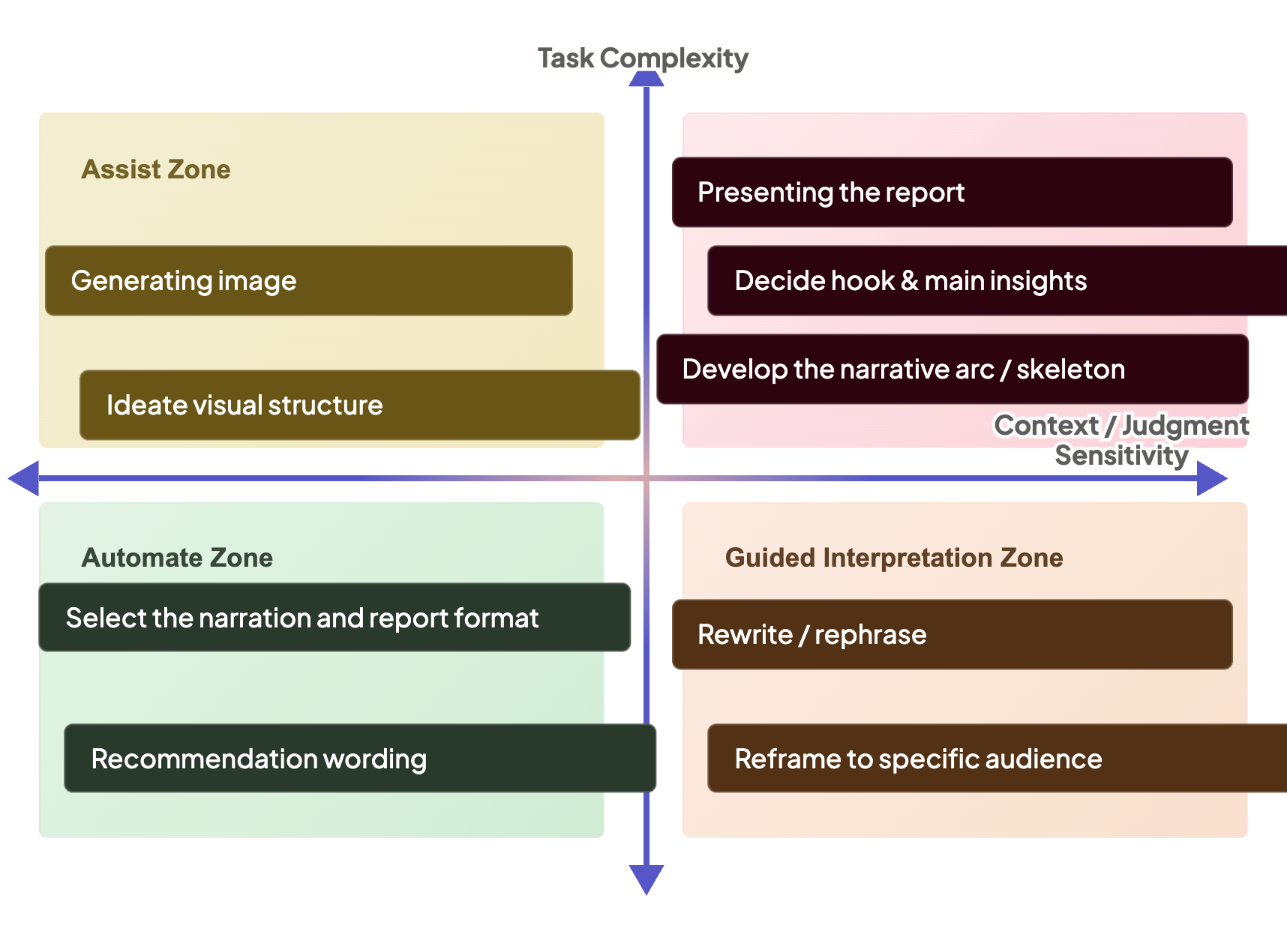
What we learn

Here the grip is at both ends: you decide what to say and you own how it lands, AI just helps with the craft in between.
The same activities, pulled into three moves:
| Step | Set the message | Craft the telling | Tailor & deliver |
|---|---|---|---|
| Activities | Choosing the story and the hook, deciding the headline insights | Drafting framing options, rewriting and rephrasing, trying narrative techniques, shaping the visuals | Adapting it to each audience, wording the recommendations |
| Zone | Human only | Assist | Human only |
| Why this zone | The story and the main point are judgement calls. You decide the main tensions, challenges or opportunities to highlight | Structure and phrasing are things AI can genuinely speed up. | |
| Watch out | Letting AI choose the headline for you. | Over-polishing until the tension — the bit that makes people care — is gone. | |
| Do this | You choose what matters most. |
Where AI helps most
AI helps one insight reach more people, rewording it for different audiences, correcting grammar and tightening the structure.
Try
“Rewrite this finding for a senior leader in three sentences, keeping the key tension right up front.”
The moment a recommendation appears, a human has to step up and own it. Enough to say, if it fails: ‘Yes, that was my call.’
5-Knowledge Management
Knowledge Management Phase
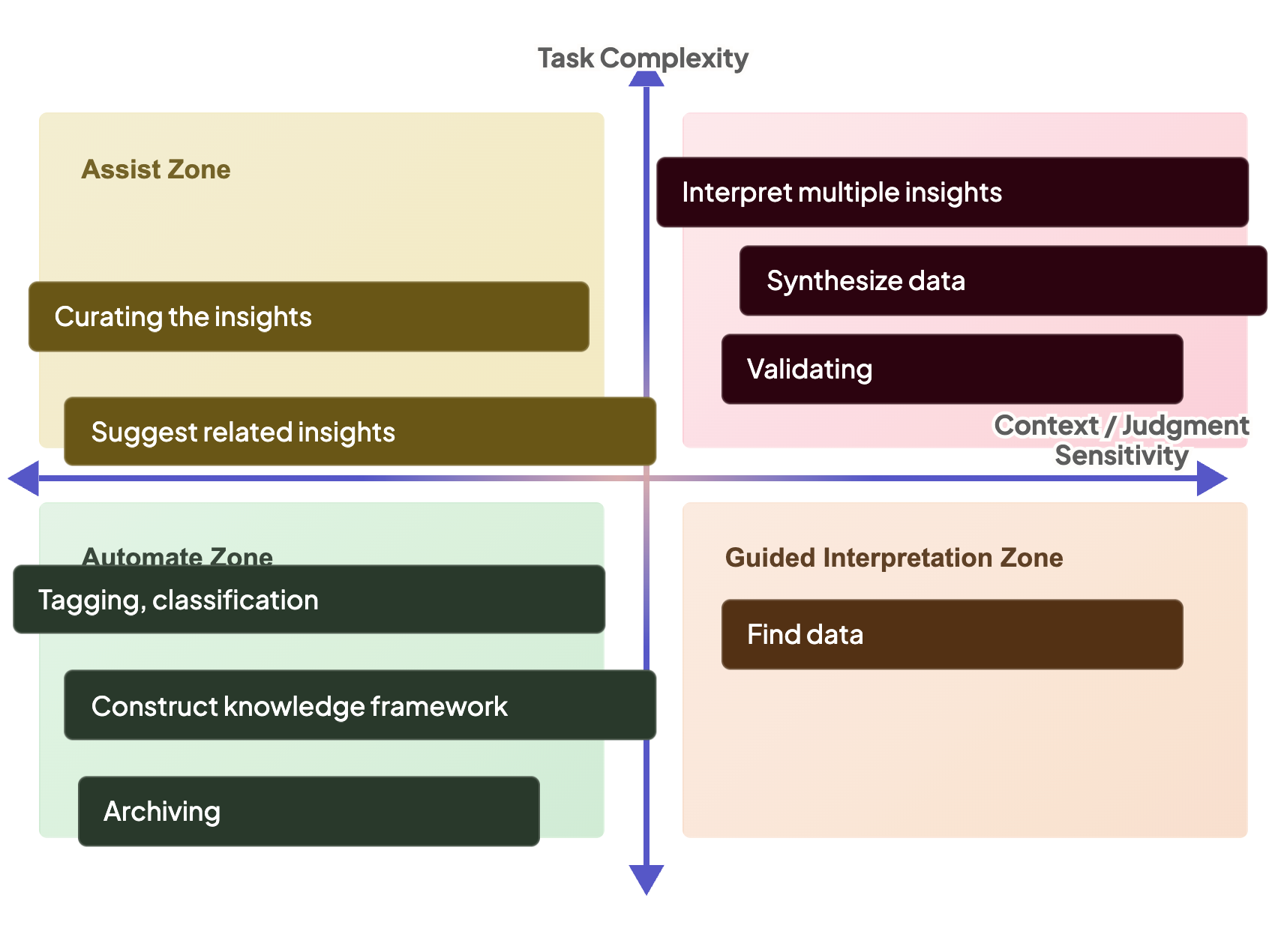
What we learn

Here the grip is at the back again: AI can remember everything, but you decide what those memories actually mean.
The same activities, pulled into three moves:
| Step | Archive & Tag | Retrieve & Connect | Synthesise over time |
|---|---|---|---|
| Activities | Storing studies, tagging, sorting, adding metadata | Suggesting related insights, spotting similar past studies, finding old work | Reading across many studies, pulling them together, checking what holds up over time |
| Zone | Automate | Assist | Human only |
| Why this zone | High volume, low judgement. | AI spots links across old work that you’d easily miss. | Meaning that spans many studies is what sets direction. |
| Watch out | Sloppy tagging makes everything impossible to find later. | AI surfacing something doesn’t make it relevant. | Mistaking “we keep seeing this” for “this is true.” |
| Do this | You set the tagging system; let AI fill it in. | You decide which links are actually real. | A named person signs off on the across-studies read. |
Where AI helps most
AI turns your archive into something you can ask questions of what keeps coming up over time, and what old work is worth digging back into.
Try
“Across these past studies, what themes keep recurring, and what has shifted over time?”
The least glamorous, highest-payoff move in research: making sure your team can find old work instead of redoing it.
The Human X AI Loop
The Human X AI Loop
The quadrant tells you where AI sits on a single task.
That is the standard. Not AI-first. Not human-only. A repeatable Human–AI execution loop across every phase.

The Spectrum
The Spectrum

The Spectrum tunes the Quadrant to the project in front of you. It asks two questions.
The two questions
| Level | Stakes: the damage if it is wrong | Sensitivity: cultural and human nuance |
|---|---|---|
| Low | Internal, for the team. Fixable within a quarter. Mistakes are cheap. | Mainstream context, general adult population, routine topics. AI blind spots will not distort much. |
| Medium | Goes to other functions or execs. Fixable within a year, but it costs. | Distinct subcultures or sensitive groups and topics such as Gen Z norms, regional culture, parenting, money habits, religious-holiday rhythms. |
| High | External-facing or hard to undo. Write-offs, public record, regulatory fallout if it is wrong. | Identity, faith, ethnicity, sexuality, regional politics, vulnerable groups, mental health. A misread can harm or offend. |
Note:
Sensitivity is a judgement call, and the call depends on who is making it. When a team spans cultures, generations, or regions, get a senior read before you settle on a level.
Once you have both answers, the next step is putting them together.
Finding your level

The level travels with the work: Pick your level from where the work will end up, not where it starts. Light notes that find their way into a client deck were never Light. If the destination changes halfway through, the level changes with it.
On calibration: These thresholds are our starting calibration, not a standard. Move them if your work says otherwise, and tell us.
What the level does to your phases
The level moves two things: how tight your grip is, and how much doubt the work has to survive before you believe it.
How the grip moves
Here is the Analysis phase at all four levels. Read down a column to watch one step tighten. Read across a row to see the shape of a level.
| Project standard | Observations | Meaning | Implications | Actions |
|---|---|---|---|---|
| Light | Automate | Assist | Guided | Human only |
| Standard | Automate | Guided | Human only | Human only |
| Elevated | Assist | Human only | Human only | Human only |
| Critical | Guided | Human only | Human only | Human only |
Everything slides except the last step. Actions carries your name on it at every level.
For solo researchers: Most of what each level asks, you can do alone: the checking, the tracing, the tighter grip. What you cannot do alone is audit your own framing, which is the whole reason the senior reviewer and the cultural advisor are on those lists. A blindspot is by definition invisible to the person who has it. Bring in a peer, a trusted outside collaborator, or a community of practice. One conversation with someone who knows the community, before you interpret, is worth more than any amount of extra desk checking.
Project AI Alignment Canvas
Frameworks don’t change practice on their own. What changes practice is a conversation with your stakeholder before the project starts. The one that, in 2026, most researchers and clients still aren’t having, even though they should be.
The AI Alignment Canvas makes that conversation cheap and structured. It’s a one-page agreement: the research lead drafts it, then walks the stakeholder through it at kickoff. It records how AI will be used on this project and, just as importantly, what AI will not touch. It carries the project’s Spectrum level forward, states what the team commits to, and asks the stakeholder for commitments in return.
Use it on every project that runs through this playbook. Re-open it the moment scope, sensitivity, or AI posture shifts mid-project.
Section 3: The Researcher
How your role evolves as the landscape shifts: you, your team, and the ground beneath you
The progress of AI won’t be stagnant nor predictable. The acceptance and readiness of AI usage in different industries and companies would not be the same either. How should we act as researchers in these different situations? While the previous chapter gives us an idea on the practicality of AI usage at each research project, this next section is aiming to give an idea on how we, the humans behind it, should be and what skills to prepare in any given possible condition of AI progress and AI usage readiness.
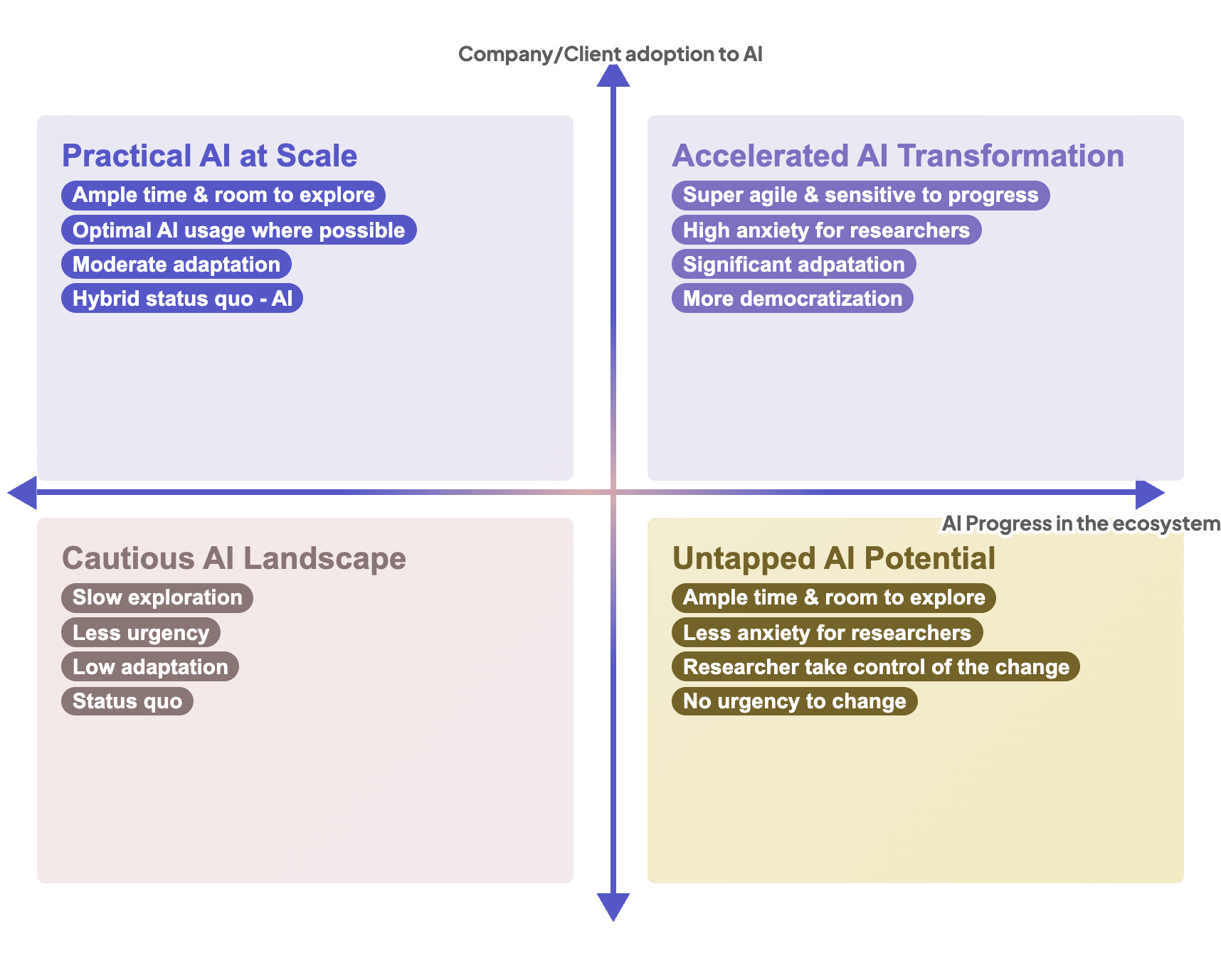
To visualise possible future scenarios, we used 2 main variables: AI progress: the speed in which AI updates its capabilities, specifically in the domain of research AI usage readiness: company/organization culture towards the embracing of AI usage
| If This Happens (Your Environment) | Then Become This (Your Strategic Pivot) | Core Human-AI Loop |
|---|---|---|
Scenario 1: Practical AI at Scale
|
The Boundary-Setter & Expectation Manager
|
Human Frames → AI Pre-Processes → Human Interprets & Justifies |
| If This Happens (Your Environment) | Then Become This (Your Strategic Pivot) | Core Human-AI Loop |
|---|---|---|
Scenario 2: Accelerated Transformation
|
The Orchestrator of Thinking Systems
|
Human Frames → AI Expands → Human Judges & Rejects → AI Stress-Tests |
| If This Happens (Your Environment) | Then Become This (Your Strategic Pivot) | Core Human-AI Loop |
|---|---|---|
Scenario 3: Untapped AI Potential
|
The Legitimizer & Translator
|
Human Works → AI Assists Quietly → Human Validates & Explains |
| If This Happens (Your Environment) | Then Become This (Your Strategic Pivot) | Core Human-AI Loop |
|---|---|---|
Scenario 4: Stagnant & Slow
|
Out of scope for this playbook
Least likely to occur. |
N/A |
| If This Happens (Your Environment) | Then Become This (Your Strategic Pivot) | Core Human-AI Loop |
|---|---|---|
Scenario 1: Practical AI at Scale
|
The Boundary-Setter & Expectation Manager
|
Human Frames → AI Pre-Processes → Human Interprets & Justifies |
Scenario 2: Accelerated Transformation
|
The Orchestrator of Thinking Systems
|
Human Frames → AI Expands → Human Judges & Rejects → AI Stress-Tests |
Scenario 3: Untapped AI Potential
|
The Legitimizer & Translator
|
Human Works → AI Assists Quietly → Human Validates & Explains |
Scenario 4: Stagnant & Slow
|
Out of scope for this playbook
Least likely to occur. |
N/A |
What we learned from this
Across all of these scenarios, what becomes clear is that AI is not redefining the purpose of research, rather it is redistributing how the work gets done. While tools may accelerate organization, generate alternatives, or support early-stage thinking, the responsibility for assigning meaning, judgment of priorities and context, also accountability of output remains firmly human.
The strongest researchers are not those who use AI the most, but those who are agile in understanding the context of their environment in respect to AI and then use it deliberately, be it by:
| Framing better questions | |
|---|---|
| ☞ | what to ask AI |
| ☞ | what NOT to ask AI |
| ☞ | how to structure a problem before involving AI |
| Evaluating outputs critically | |
|---|---|
| ☞ | spot when AI output is shallow, generic, or overconfident |
| ☞ | detect missing nuance or flattened meaning |
| ☞ | compare AI-generated patterns with actual data |
| Making their reasoning visible to others | |
|---|---|
| ☞ | where AI was introduced |
| ☞ | what steps remained human-led |
| Boundary-setting | |
|---|---|
| ☞ | where AI adds value |
| ☞ | where it introduces risk |
| ☞ | where it should not be used |
And being able to communicate that clearly.
As AI becomes more embedded in everyday workflows, the real differentiator is not speed, but clarity: knowing where AI adds value, where it introduces risk, and how to ensure that insight remains grounded, defensible, and useful. In this shift, the role of the researcher does not diminish, rather it becomes more focused, more visible, and ultimately, more important.
Outro: A Living, Community-Driven Guide
The intersection of research and artificial intelligence is a shifting landscape. The principles, workflows, and strategic responses outlined here are not stone-carved rules, but a dynamic compass designed to adapt as AI capabilities evolve and organizational expectations change.
This playbook is the direct product of our collective wisdom and real-world field testing. It was shaped by a community of researchers navigating the messy, nuanced reality of modern insights together. Because the landscape changes daily, this document will remain entirely community-driven. As we move through this season of transition together, we will continue to co-create, stress-test, and update these guidelines based on what we encounter on the ground.
Do not treat this as a static reference manual. Use it as a living guide to audit your current environment, re-calibrate your human-AI loop, and share your own learnings back with the collective. The ultimate goal is not to build a rigid boundary around how we work, but to foster a resilient, highly adaptive community that thrives no matter how fast the technology moves.
Keep testing, keep sharing, and keep the human texture in the room. We run this season together.